A trophic cascade is an ecological situation where the introduction or removal of a predator near the top of the food chain causes population changes all through the food chain. The case of interest to me is predators that chase large grazing animals.
Every continent except Antarctica has large, grazing animals, and many of the ecosystems within those continents. Most tend to group together in large herds, which find a happy place to graze, until a predator attacks them, at which point they run and find a new happy grazing place. The grasses they eat have developed in symbiosis with these grazing animals--it gets trampled and eaten, but the soil gets kicked around and a fresh supply of rich fertilizer gets left behind, as well as any fresh seeds that may have stuck to the grazers fur or survived the passage through its gut. As long as the grazers don't spend too long, it's good for the grass.
We humans have interfered with this process. Some grazers have been domesticated, and they stay in one place, often penned in, until the grass is gone, and then we provide them with hay or grain from some other place while they continue to destroy the land they are captive on. In other places, we've removed the predator, which removes the incentive for the animals to move now and then. An example is the mountain meadows of the rockies. When there were wolves, the elk could only stay in the bottomlands for a short time, and the grass grew slowed the creek. Beaver and other creatures came and made further changes, slowing the creek further and turning parts of it to wetlands, bringing even more diversity. A classic trophic cascade. Removing the wolves allowed the elk to eat all the grass in easiest place to get it, the bottomland, and the creek became a roaring stream and washed all of this away. Restoring even a few wolves after they'd been gone for a century brought it all back.
I've been reading about Joel Salatin and Allan Savory. They both come at this from a slightly different angle but they're saying the same thing. Salatin has developed a method of raising cattle and chickens where fences in a small herd--100 or so--and moves them almost every day. He sizes the pasture so that they consume most, but not quite all, of the best grass before he moves them. A few days later, he hauls a henhouse to the same pasture, where the chickens pick over the manure. He doesn't bring the cattle back until the grass is completely recovered, which happens pretty fast, because he didn't let cows graze too long. He points out that any bovine parasites that the birds eat don't go any farther, and the same is true of chicken parasites that the cattle may eat, so the animals are much healthier than their relatives on farms nearby. The grass is way healthier, and he says he gets more than 4 times the beef productivity for the same amount of land grazed the traditional way, and the eggs are essentially free.
Allan Savory has been trying to reverse desertification in Africa.. He tried reducing the trampling, including culling 40,000 elephants at one point, but that only exacerbated the desertification. What has worked, very much to his surprise, was encouraging cattle herders to graze their animals temporarily. Places where all the grass was gone but still had brush for the cattle to eat began to sprout grass a few days after the cattle left, and with each visit it became healthier. The animals become healthier too. The key is to not let the animals eat it all. The herders are playing the role of the predator. Perhaps, but maybe not, coincidentally, the herders have been finding that their animals are about 4 times as productive when they feed them this way, just as Joel Salatin has.
Grass and trees are the best way we have to reduce CO2 in the atmosphere. The carbon that makes up these plants cells is entirely extracted from atmospheric CO2. Monoculture agriculture is ruining our land, and making our crops, our animals and ourselves unhealthy.
03 July 2018

18 June 2018
Technical Errors in "The Martian"
Andy Weir's The Martian is one of the most technically accurate science fiction stories of all time, although it's not perfect. I just re-watched the excellent movie, which followed the book unusually well. This critique is based on the movie:
Martian atmosphere is about 1/10th that of earth. The wind would not carry all that much energy, even if it's blowing 200mph, and it's hard to imagine it knocking over the MAV or carrying enough sand that the sand might do it. The pictures of dust devils taken by the rovers are scrawny little things. It is plausible that it might cause flight in lightweight things that aren't fastened down properly, such as satellite dishes, so the incident that seems to have killed Watney is remotely possible, but the crew would have simply hunkered down and ridden it out.
The Aries 4 MAV is already on Mars, 4 years ahead of its use. Mission planners expect it to still be standing when the Aries 4 mission arrives, despite frequent sandstorms that apparently can knock a MAV over?
It is inconceivable that a month long surface mission wouldn't have several redundant transceivers that could quickly reestablish communication between a marooned spaceman and earth, even if the primary went back into space with the rest of the crew. For example, I'd think each rover would have had a high gain antenna analogous to the one on Pathfinder--about a foot in diameter: a phased array with relatively low bandwidth and only needs to be aimed in the right general direction to obtain maximum gain. Not quite enough bandwidth for SDTV video, adequate for voice, and more than adequate for TTY and still photography.
It doesn't make much sense to have a specialist botanist on an early Mars exploration mission. A different specialty scientist who happened to have a background in botany, perhaps, but not a specialist. Had I been in Andy Weir's place, I'd have had Watney have been a farm boy who grew up to be a scientist (geologist perhaps?) and astronaut. Growing potatoes in martian soil and human manure is pretty basic farm stuff. I'm pretty sure I could do it and I'm not a farm boy or botanist at all.
Watney manages to keep his potato harvest healthy for over a year after the breach, in the same atmosphere he's living in. It's probably impossible to keep bacteria and fungus from his own body from infecting them. I can't keep potatoes for more than a few months, unless I freeze them. The originals from earth probably survived this way too: vacuum packed and frozen. He'd have protected his harvest exactly this way, and they would have survived the HAB breach, and he could have started up his garden again.
The HAB is soft skinned. This is plausible as a covering for non-human stuff and even short term habitation, but unless there is some sort of magic radiation shielding developed between now and then, totally implausible for a month long habitation. The astronauts might survive, but probably not for long enough to make it home. I think the only real answer is to put the dwelling underground.
The same point holds for the Hermes interplanetary ship. They got a lot right for the Hermes design, but there's no evident shielding, which should probably be ten feet thick or more around crew areas.
A great deal of space on the Hermes is given to human-occupied areas in microgravity. I would doubt there would be many--airlocks and docking berths--but you wouldn't expect the astronauts to need to go through them very often.
The calculations Rich Purnell needs to solve to work out the maneuver are mathematical and demand high precision, but are not especially complex. He wouldn't need a supercomputer to solve them. The laptop on his desk would be ample. (had he been doing it in 1966, he might have needed a supercomputer, but the PC I'm using to type this is about 300 times faster than a CDC 6600, the fastest machine of 1966). Even if he did need a supercomputer for some reason, he wouldn't have needed to leave his office to do it. (that said: I met an "Orbits" guy when I worked at Lockheed Missiles and Space. The eccentric Rich Purnell character is totally plausible.)
The MAVs (both Aries 3 and 4) are entered through an airlock in the middle of the floor. Underneath that floor is the second stage of the ascent rocket and underneath that is the first stage. Wrong. The astronauts would climb up the MAV on the outside and enter through a door in the side.
When Watney enters the MAV with his EVA suit on, he enters through this same airlock door, and closes and fastens it. It is obviously a big heavy thing. I'd think it'd have been among the first things to be tossed overboard.
The nose cone is shown sliding right past the MAVs attitude control jets. Watney is going to need those. He'd have figured out some way to guarantee not breaking them.
I don't understand why they needed to blow the airlock door. They can override other safeties, why not that one? It does make a fun plot element though.
We see personal laptop computers from Commander Lewis, Johansen and Watney, and we can be sure the others left theirs behind too. Why is it that only Lewis has recorded music on hers?
addenda:
Water has recently been discovered on Mars, trapped in rocks, plentiful and reasonably easy to obtain. This spoils one of the central plot elements, although Weir couldn't have known that when he wrote the book.
I read Weir's latest, Artemis. It's almost as good as The Martian.
Martian atmosphere is about 1/10th that of earth. The wind would not carry all that much energy, even if it's blowing 200mph, and it's hard to imagine it knocking over the MAV or carrying enough sand that the sand might do it. The pictures of dust devils taken by the rovers are scrawny little things. It is plausible that it might cause flight in lightweight things that aren't fastened down properly, such as satellite dishes, so the incident that seems to have killed Watney is remotely possible, but the crew would have simply hunkered down and ridden it out.
The Aries 4 MAV is already on Mars, 4 years ahead of its use. Mission planners expect it to still be standing when the Aries 4 mission arrives, despite frequent sandstorms that apparently can knock a MAV over?
It is inconceivable that a month long surface mission wouldn't have several redundant transceivers that could quickly reestablish communication between a marooned spaceman and earth, even if the primary went back into space with the rest of the crew. For example, I'd think each rover would have had a high gain antenna analogous to the one on Pathfinder--about a foot in diameter: a phased array with relatively low bandwidth and only needs to be aimed in the right general direction to obtain maximum gain. Not quite enough bandwidth for SDTV video, adequate for voice, and more than adequate for TTY and still photography.
It doesn't make much sense to have a specialist botanist on an early Mars exploration mission. A different specialty scientist who happened to have a background in botany, perhaps, but not a specialist. Had I been in Andy Weir's place, I'd have had Watney have been a farm boy who grew up to be a scientist (geologist perhaps?) and astronaut. Growing potatoes in martian soil and human manure is pretty basic farm stuff. I'm pretty sure I could do it and I'm not a farm boy or botanist at all.
Watney manages to keep his potato harvest healthy for over a year after the breach, in the same atmosphere he's living in. It's probably impossible to keep bacteria and fungus from his own body from infecting them. I can't keep potatoes for more than a few months, unless I freeze them. The originals from earth probably survived this way too: vacuum packed and frozen. He'd have protected his harvest exactly this way, and they would have survived the HAB breach, and he could have started up his garden again.
The HAB is soft skinned. This is plausible as a covering for non-human stuff and even short term habitation, but unless there is some sort of magic radiation shielding developed between now and then, totally implausible for a month long habitation. The astronauts might survive, but probably not for long enough to make it home. I think the only real answer is to put the dwelling underground.
The same point holds for the Hermes interplanetary ship. They got a lot right for the Hermes design, but there's no evident shielding, which should probably be ten feet thick or more around crew areas.
A great deal of space on the Hermes is given to human-occupied areas in microgravity. I would doubt there would be many--airlocks and docking berths--but you wouldn't expect the astronauts to need to go through them very often.
The calculations Rich Purnell needs to solve to work out the maneuver are mathematical and demand high precision, but are not especially complex. He wouldn't need a supercomputer to solve them. The laptop on his desk would be ample. (had he been doing it in 1966, he might have needed a supercomputer, but the PC I'm using to type this is about 300 times faster than a CDC 6600, the fastest machine of 1966). Even if he did need a supercomputer for some reason, he wouldn't have needed to leave his office to do it. (that said: I met an "Orbits" guy when I worked at Lockheed Missiles and Space. The eccentric Rich Purnell character is totally plausible.)
The MAVs (both Aries 3 and 4) are entered through an airlock in the middle of the floor. Underneath that floor is the second stage of the ascent rocket and underneath that is the first stage. Wrong. The astronauts would climb up the MAV on the outside and enter through a door in the side.
When Watney enters the MAV with his EVA suit on, he enters through this same airlock door, and closes and fastens it. It is obviously a big heavy thing. I'd think it'd have been among the first things to be tossed overboard.
The nose cone is shown sliding right past the MAVs attitude control jets. Watney is going to need those. He'd have figured out some way to guarantee not breaking them.
I don't understand why they needed to blow the airlock door. They can override other safeties, why not that one? It does make a fun plot element though.
We see personal laptop computers from Commander Lewis, Johansen and Watney, and we can be sure the others left theirs behind too. Why is it that only Lewis has recorded music on hers?
addenda:
Water has recently been discovered on Mars, trapped in rocks, plentiful and reasonably easy to obtain. This spoils one of the central plot elements, although Weir couldn't have known that when he wrote the book.
I read Weir's latest, Artemis. It's almost as good as The Martian.
13 May 2018
Slow Growth Policies
A lot of cities are struggling with unbalanced growth: some sections are getting intense gentrification and densification. This unfortunately, is inevitable. I happen to live in Seattle, so I'll use it as an example.
The symbol of Seattle densification is Amazon.com, which has built an urban campus in an area called South Lake Union--because it is south of a small lake called Lake Union. The area used to be part of what was called "The Denny Regrade." In the 1920s a steep hill named for city founder Arthur Denny, a little north of downtown, was sluiced down and the area leveled using hydraulic mining techniques. It became an area of small industry and commercial buildings, cheap apartments, dive bars and other relatively low cost business. The Seattle Center, site of the 1962 Worlds Fair, was built on one part of it, and the largest freeway off and on ramps in the city passed through it, in a convoluted group of roads that came to be called "The Mercer Mess" after the biggest of the streets involved. In the 1990s, a group led by Paul Allen began buying up properties with the goal of revitalizing one part of the Regrade and fixing the Mercer Mess.
The timing and location turned out to be perfect for Amazon, which moved its headquarters into SLU, and began to grow. And grow. And grow. Tens of thousands of young professionals came to Seattle to work at Amazon. City life suited them and they very quickly changed the dynamic of the area. Where it had been a semi-suburban part of the city, where coming and going was all about the automobile, it suddenly became nearly impossible to find parking and very difficult to even get your car from one side to the other. The Mercer Mess is symbolic: where it had been nominally 4 lanes in each direction with only a few traffic lights and pretty good access to the rest of the city, now it's 3 lanes in each direction with a traffic light every block and during rush hour, traffic is so dense it often takes more half an hour to get on to Mercer from a side street. The Amazon workers resorted to moving within walking distance of work, and consequently there are dozens of new, expensive high rises within walking distance.
The people who were already here were screwed. Thousands of people were kicked out of low rent housing, unable to find affordable housing within 20 miles or more of the area, which for most had also been where they worked. Seattle is very much a car-focused region and city. There are some symbolic transit systems, which do work, but their capacity is very low and the better ones cover very, very little of the region. The bus system has better coverage, but it is terribly limited. For example, the place I used to live in Redmond had service once an hour, from 6am to 7pm. It was a half mile walk. Heaven help a cripple, or someone carrying something big. It had even shorter hours on weekends.
The Seattle City Council wants to impose a "Head Tax" to employers over some threshold size. I think there's the germ of a good idea in this, but the goal is mistaken. They're trying to discourage big businesses from building downtown. I think the right thing to do is to tax businesses to build transit. Grade separated transit, so it can reduce congestion. Long distance transit, so the people who want to work downtown can get to housing where it's affordable, and people who want to live downtown can get to businesses that are located where it's affordable.
The symbol of Seattle densification is Amazon.com, which has built an urban campus in an area called South Lake Union--because it is south of a small lake called Lake Union. The area used to be part of what was called "The Denny Regrade." In the 1920s a steep hill named for city founder Arthur Denny, a little north of downtown, was sluiced down and the area leveled using hydraulic mining techniques. It became an area of small industry and commercial buildings, cheap apartments, dive bars and other relatively low cost business. The Seattle Center, site of the 1962 Worlds Fair, was built on one part of it, and the largest freeway off and on ramps in the city passed through it, in a convoluted group of roads that came to be called "The Mercer Mess" after the biggest of the streets involved. In the 1990s, a group led by Paul Allen began buying up properties with the goal of revitalizing one part of the Regrade and fixing the Mercer Mess.
The timing and location turned out to be perfect for Amazon, which moved its headquarters into SLU, and began to grow. And grow. And grow. Tens of thousands of young professionals came to Seattle to work at Amazon. City life suited them and they very quickly changed the dynamic of the area. Where it had been a semi-suburban part of the city, where coming and going was all about the automobile, it suddenly became nearly impossible to find parking and very difficult to even get your car from one side to the other. The Mercer Mess is symbolic: where it had been nominally 4 lanes in each direction with only a few traffic lights and pretty good access to the rest of the city, now it's 3 lanes in each direction with a traffic light every block and during rush hour, traffic is so dense it often takes more half an hour to get on to Mercer from a side street. The Amazon workers resorted to moving within walking distance of work, and consequently there are dozens of new, expensive high rises within walking distance.
The people who were already here were screwed. Thousands of people were kicked out of low rent housing, unable to find affordable housing within 20 miles or more of the area, which for most had also been where they worked. Seattle is very much a car-focused region and city. There are some symbolic transit systems, which do work, but their capacity is very low and the better ones cover very, very little of the region. The bus system has better coverage, but it is terribly limited. For example, the place I used to live in Redmond had service once an hour, from 6am to 7pm. It was a half mile walk. Heaven help a cripple, or someone carrying something big. It had even shorter hours on weekends.
The Seattle City Council wants to impose a "Head Tax" to employers over some threshold size. I think there's the germ of a good idea in this, but the goal is mistaken. They're trying to discourage big businesses from building downtown. I think the right thing to do is to tax businesses to build transit. Grade separated transit, so it can reduce congestion. Long distance transit, so the people who want to work downtown can get to housing where it's affordable, and people who want to live downtown can get to businesses that are located where it's affordable.
11 February 2018
What If Smallpox Hadn't Cleared America?
This map has been circulating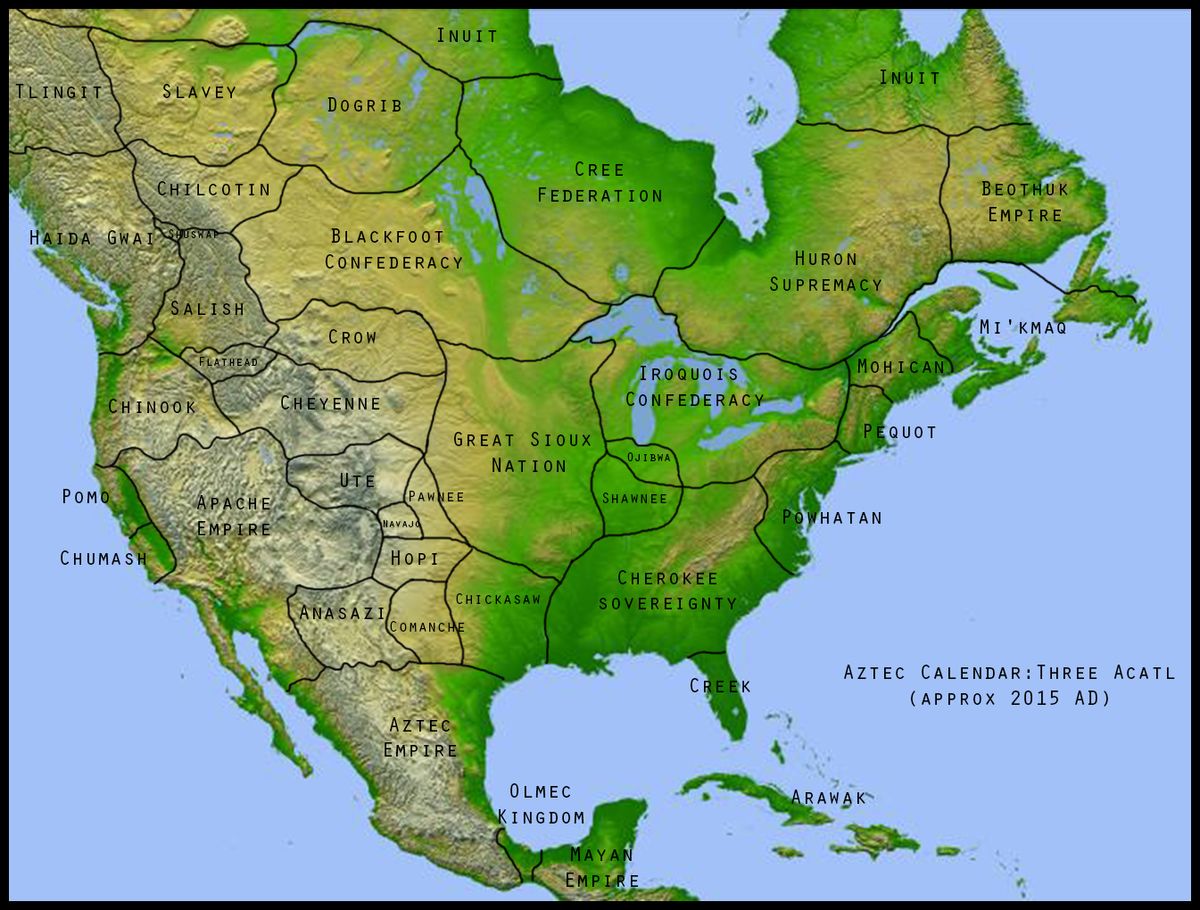
It purports to show what would have happened had Europeans never come to America. It's not accurate; it's a projection by someone writing speculative history of what would have happened to the various native groups 500 years after Columbus. It's completely bogus: Europeans did come to America, their way eased by Smallpox and other pestilence, and these borders are quite different than what they found. The Europeans would have come to America eventually, no matter what happened. The Vikings had come 500 years before Columbus, and there were lots of other explorers who would have found their way here sooner or later had Columbus somehow failed. But it's an interesting question: what might have been different if Columbus and his peers had met with credible resistance?
In 1492, Europe had the most advanced civilizations in the world, but not by much. China and the Middle Eastern civilizations had been more advanced only a century or so earlier, and there were at least two unrelated civilizations in America that were not far behind, too. No doubt Europe was advancing faster than the rest, fostered by enlightened rejection of the authoritarianism and religious fundamentalism that had held them back for a millennium.
But Europe was able to overrun the New World, not by the sophistication of their technology, although that helped in some places, and certainly not because of their religion, but because they were preceded by devastating disease, especially smallpox, but probably also plague and others, which the first explorers had brought along with them. The English settlers that arrived in Virginia and New England 120 years after Columbus were surprised to discover fallow agricultural land that had already been cleared and a native population that was willing to teach them how to farm it. Cortez and Pizzaro, arriving a century earlier, were similarly able to exploit the political disruptions caused by the disease.
What would have happened had disease somehow not been so effective against the natives? We have a few hints: The Vikings made a few incursions and were, in all but one case, driven back by the locals, who they called "Skraelings". In the one exception, their settlement was in the northmost part of Newfoundland, where life was too hard for the natives, and the Vikings also gave up and went home after a few decades. In the places that the natives had a few centuries after Columbus to recover, such west of the Appalachians, and especially the US great plains, the natives fought back pretty hard and it took a very big army to defeat them.
We can imagine a scenario where things had gone this way across the continent: Cortez attacked Mexico barely 20 years into the devastation. What if the timing had been different by a few decades and the Aztecs who had immunity to Smallpox had had a chance to repopulate? Cortez would have met fierce resistance, and certainly wouldn't have been able to conquer so thoroughly. Something more resembling what happened in India or China is a lot more likely: trading outposts supported by military would have left the existing civilization roughly intact, and European dominance would have needed to be more insidious and commercial in character. The native civilizations would have been changed radically by the outsiders, but there would be a clear political and cultural lineage to this day, where in fact they were truncated--little pieces of their own culture merged into the dominant European one. There would be plenty of Europeans in America, just as there are plenty of Asians and Africans in Europe, but something like the map above might have happened.
It purports to show what would have happened had Europeans never come to America. It's not accurate; it's a projection by someone writing speculative history of what would have happened to the various native groups 500 years after Columbus. It's completely bogus: Europeans did come to America, their way eased by Smallpox and other pestilence, and these borders are quite different than what they found. The Europeans would have come to America eventually, no matter what happened. The Vikings had come 500 years before Columbus, and there were lots of other explorers who would have found their way here sooner or later had Columbus somehow failed. But it's an interesting question: what might have been different if Columbus and his peers had met with credible resistance?
In 1492, Europe had the most advanced civilizations in the world, but not by much. China and the Middle Eastern civilizations had been more advanced only a century or so earlier, and there were at least two unrelated civilizations in America that were not far behind, too. No doubt Europe was advancing faster than the rest, fostered by enlightened rejection of the authoritarianism and religious fundamentalism that had held them back for a millennium.
But Europe was able to overrun the New World, not by the sophistication of their technology, although that helped in some places, and certainly not because of their religion, but because they were preceded by devastating disease, especially smallpox, but probably also plague and others, which the first explorers had brought along with them. The English settlers that arrived in Virginia and New England 120 years after Columbus were surprised to discover fallow agricultural land that had already been cleared and a native population that was willing to teach them how to farm it. Cortez and Pizzaro, arriving a century earlier, were similarly able to exploit the political disruptions caused by the disease.
What would have happened had disease somehow not been so effective against the natives? We have a few hints: The Vikings made a few incursions and were, in all but one case, driven back by the locals, who they called "Skraelings". In the one exception, their settlement was in the northmost part of Newfoundland, where life was too hard for the natives, and the Vikings also gave up and went home after a few decades. In the places that the natives had a few centuries after Columbus to recover, such west of the Appalachians, and especially the US great plains, the natives fought back pretty hard and it took a very big army to defeat them.
We can imagine a scenario where things had gone this way across the continent: Cortez attacked Mexico barely 20 years into the devastation. What if the timing had been different by a few decades and the Aztecs who had immunity to Smallpox had had a chance to repopulate? Cortez would have met fierce resistance, and certainly wouldn't have been able to conquer so thoroughly. Something more resembling what happened in India or China is a lot more likely: trading outposts supported by military would have left the existing civilization roughly intact, and European dominance would have needed to be more insidious and commercial in character. The native civilizations would have been changed radically by the outsiders, but there would be a clear political and cultural lineage to this day, where in fact they were truncated--little pieces of their own culture merged into the dominant European one. There would be plenty of Europeans in America, just as there are plenty of Asians and Africans in Europe, but something like the map above might have happened.
26 January 2018
Emigration and Authoritarianism
Trump started his campaign with the astonishing statement that "They're not sending their best." A few weeks ago he wondered why it's only shithole countries that send people here, why nobody from Norway? Ignoring the obvious racism underlying both statements and many others, it expresses a deep misunderstanding of what emigration is. People don't leave their home because some central authority is ordering them to (although there are a few exceptions: the Trail of Tears, Slavery of Africans, a few others). Leaving home is traumatic. You don't do it unless there's a pretty good reason. The families of three of my four grandparents all came here because they believed it was likely that someone in the old country would kill them--not because they'd done anything wrong, but because of their ethnicity. People leave the old country because there's a war happening, as presently in Syria and several Latin American countries, or because there's a famine or some other terrible circumstance. A tiny fraction of people leave the old country even though they were doing ok in the old one because there's a terrific opportunity in the new one. High tech "brain drain" is one of the few examples of this. People aren't leaving Norway for a very simple reason: Norway has one of the strongest economies in the world and has among the best social safety nets--so even if things aren't going so well for you, Norway is a good place to be.
The big excitement of the moment in anthropology is the discovery that rather than a single wave of emigration from Africa, there is clear evidence that there have been many waves of emigration that took place over many thousands of years. There's even a little evidence that there may have been humans in America 130,000 years ago, ten times what had previously been thought.
I find myself astonished that anybody ever thought that there was a single wave. The forces that drive emigration--famine, war, the search for a better opportunity--are driven by individuals, not by some central organizing force. Africa is a big continent. The first humans probably spread from wherever they evolved to somewhere nearby. The grass may have been greener, hunting may have been better, another tribe or species was out competing them or killing them and they wanted to get away. Before long, some group found their way to other continents. Surely this happened thousands of times over a hundred thousand years.
Humans are naturally curious, and some humans are more curious than others. The first Americans to explore the west were more curious about what lay over the next hill than they were hungry or desperate. With very few exceptions, this was an internal thing. They had unquenchable wanderlust. Even Lewis and Clark were doing it because they wanted to--the sponsorship made the trip easier. The first explorers, 100,000 years ago or more, surely were the prehistoric version of James Bridger and Lewis and Clark. It's easy to imagine some band, or possibly even an individual, driven by wanderlust or perhaps their raft was simply blown off course, finding their way to America, and unable to get back, or perhaps uninterested, making the best of it. Most such bands died out, just as the 11th century Vikings who settled in Newfoundland did. But a few made it.
The big excitement of the moment in anthropology is the discovery that rather than a single wave of emigration from Africa, there is clear evidence that there have been many waves of emigration that took place over many thousands of years. There's even a little evidence that there may have been humans in America 130,000 years ago, ten times what had previously been thought.
I find myself astonished that anybody ever thought that there was a single wave. The forces that drive emigration--famine, war, the search for a better opportunity--are driven by individuals, not by some central organizing force. Africa is a big continent. The first humans probably spread from wherever they evolved to somewhere nearby. The grass may have been greener, hunting may have been better, another tribe or species was out competing them or killing them and they wanted to get away. Before long, some group found their way to other continents. Surely this happened thousands of times over a hundred thousand years.
Humans are naturally curious, and some humans are more curious than others. The first Americans to explore the west were more curious about what lay over the next hill than they were hungry or desperate. With very few exceptions, this was an internal thing. They had unquenchable wanderlust. Even Lewis and Clark were doing it because they wanted to--the sponsorship made the trip easier. The first explorers, 100,000 years ago or more, surely were the prehistoric version of James Bridger and Lewis and Clark. It's easy to imagine some band, or possibly even an individual, driven by wanderlust or perhaps their raft was simply blown off course, finding their way to America, and unable to get back, or perhaps uninterested, making the best of it. Most such bands died out, just as the 11th century Vikings who settled in Newfoundland did. But a few made it.
16 December 2017
SETI
I am certain that there is extraterrestrial life out there and I am pretty sure some of it is intelligent. The universe is so vast and the number of planets so enormous that anything else strains credulity. But the distances are so vast and the number of dead planets so enormous that the chances of us discovering them or them discovering us is so small that the possibility of that happening also seems pretty small. The distances are enormous. Most of the stars we see are hundreds of light years away and those are our nearby neighbors. Our galaxy is over 100,000 light years across. The nearest big galaxy, Andromeda, is 2.5 million light years away. The laws of physics that we know preclude travel faster than the speed of light. To send a fleet of a million probes, to visit every star in our galaxy, traveling at light speed, would take half a million years.
But, you ask, isn't it possible that there's a way to travel faster than light? You'd have to do this by warping space through a higher dimension, most likely time. We know a little about this: Galaxy-sized masses warp space enough that light is curved a few micro-seconds of arc. Enough to detect with powerful instruments, but the space-warp available from this is not actually any faster than the speed of light. I remain hopeful that some unknown technology allows us to do this but we are very far from any plausible breakthrough. Let's say that such a breakthrough occurs--we can go 1000 times faster than light--our million probes would still take at least 500 years to visit every star. Even at 1000 times light speed, our nearest star is a day and a half away.
What if some other intelligent species is out there, looking for us? If they already have 1000x light speed travel and did a search using a million probes to find us, they are at least a few hundred years more technically advanced. Could we, using the highest technology available to us, successfully hide from the best technology the 18th century had to look for us? Of course we could. We could paint an orbiting telescope flat black and spy on them from space. We could find places where they aren't and send a lander--appearing at worst to be a meteorite. We could send out drones from that lander to watch from a distance. We'd design the drones so they'd easily be mistaken for a bird or some other creature.
Or you point out that we're sending out massive quantities of radio waves. That's true, but each of these signals, on an interstellar scale, is pretty weak, and while individually coherent, from 100 light years away it's likely just a bunch of incoherent noise, and compared to what the sun generates, pretty weak at that. It may be enough to help them find us--but the waves only travel at light speed, which means the probe that detects them must be within a sphere about 100 light years in radius of us. It shortens the search, but only a decade or so.
The bottom line is that an intelligent extraterrestrial that wants to hide from us, will successfully hide from us. If they want us to see them, we will. Searching for ExtraTerrestrial Intelligence is basically a fool's errand at this point in human development. Once we have the technology to actually embark on the faster than light search, this may change. But for now, if they're looking, they're gonna find us, whether we're helping or not.
That said, I certainly don't object to privately funded SETI projects. There's lots of peripheral research being done, some of which may prove useful regardless of whether there are extraterrestrials involved or not. The SETI Institute in California does lots of space-related research, lots of it interesting and potentially useful, and as far as I can tell, only a small fraction is actually in pursuit of aliens. It's just that I think there are better things to spend my tax money on. On the other hand, I think the search for extraterrestrial life in the solar system is a worthwhile goal. We're still in the early days of exploring the solar system and it's entirely possible that there's life on one of the moons of the gas giants, or much less likely, on Mars in the dim past. Odds are very unlikely that it's even multicellular life but whatever it is, we'd like to know about it. (life has existed on earth for well over 3B years. Multicellular life for less than 1B)
addenda 18Dec2017
Over the weekend, the pentagon's own UFO research organization came to light. There are lots and lots of UFO sightings, many of them by completely credible people. I've seen two myself. One turned out to be a rocket launch from nearby Vandenberg Air Force Base in unusual atmospheric conditions, which left a long glowing trail. The other was almost certainly a meteor falling close enough that I could see it tumble and burn, but it might have been falling space debris. Strictly speaking, there was a time when, for me at least, they were unidentified. I know someone who managed to get a flying saucer photo published: it was a lid from a cooking pan, tossed in the air and spinning fast, and in poor focus. An at least superficial investigation should be easily available. A central clearing house can quickly dismiss the vast majority for what they are. Occasionally something mysterious does turn up, and these should be investigated. Yes, there are plenty of cranks in the world
But, you ask, isn't it possible that there's a way to travel faster than light? You'd have to do this by warping space through a higher dimension, most likely time. We know a little about this: Galaxy-sized masses warp space enough that light is curved a few micro-seconds of arc. Enough to detect with powerful instruments, but the space-warp available from this is not actually any faster than the speed of light. I remain hopeful that some unknown technology allows us to do this but we are very far from any plausible breakthrough. Let's say that such a breakthrough occurs--we can go 1000 times faster than light--our million probes would still take at least 500 years to visit every star. Even at 1000 times light speed, our nearest star is a day and a half away.
What if some other intelligent species is out there, looking for us? If they already have 1000x light speed travel and did a search using a million probes to find us, they are at least a few hundred years more technically advanced. Could we, using the highest technology available to us, successfully hide from the best technology the 18th century had to look for us? Of course we could. We could paint an orbiting telescope flat black and spy on them from space. We could find places where they aren't and send a lander--appearing at worst to be a meteorite. We could send out drones from that lander to watch from a distance. We'd design the drones so they'd easily be mistaken for a bird or some other creature.
Or you point out that we're sending out massive quantities of radio waves. That's true, but each of these signals, on an interstellar scale, is pretty weak, and while individually coherent, from 100 light years away it's likely just a bunch of incoherent noise, and compared to what the sun generates, pretty weak at that. It may be enough to help them find us--but the waves only travel at light speed, which means the probe that detects them must be within a sphere about 100 light years in radius of us. It shortens the search, but only a decade or so.
The bottom line is that an intelligent extraterrestrial that wants to hide from us, will successfully hide from us. If they want us to see them, we will. Searching for ExtraTerrestrial Intelligence is basically a fool's errand at this point in human development. Once we have the technology to actually embark on the faster than light search, this may change. But for now, if they're looking, they're gonna find us, whether we're helping or not.
That said, I certainly don't object to privately funded SETI projects. There's lots of peripheral research being done, some of which may prove useful regardless of whether there are extraterrestrials involved or not. The SETI Institute in California does lots of space-related research, lots of it interesting and potentially useful, and as far as I can tell, only a small fraction is actually in pursuit of aliens. It's just that I think there are better things to spend my tax money on. On the other hand, I think the search for extraterrestrial life in the solar system is a worthwhile goal. We're still in the early days of exploring the solar system and it's entirely possible that there's life on one of the moons of the gas giants, or much less likely, on Mars in the dim past. Odds are very unlikely that it's even multicellular life but whatever it is, we'd like to know about it. (life has existed on earth for well over 3B years. Multicellular life for less than 1B)
addenda 18Dec2017
Over the weekend, the pentagon's own UFO research organization came to light. There are lots and lots of UFO sightings, many of them by completely credible people. I've seen two myself. One turned out to be a rocket launch from nearby Vandenberg Air Force Base in unusual atmospheric conditions, which left a long glowing trail. The other was almost certainly a meteor falling close enough that I could see it tumble and burn, but it might have been falling space debris. Strictly speaking, there was a time when, for me at least, they were unidentified. I know someone who managed to get a flying saucer photo published: it was a lid from a cooking pan, tossed in the air and spinning fast, and in poor focus. An at least superficial investigation should be easily available. A central clearing house can quickly dismiss the vast majority for what they are. Occasionally something mysterious does turn up, and these should be investigated. Yes, there are plenty of cranks in the world
11 December 2017
We Need A Better Word for Democratic Socialist
First the spectrum, as I see it. At one extreme is communism, where the means of production and all control of it are by "the workers". The reality of this is that it is impossible. If the group is too large, decisionmaking becomes dangerously unweildy and in too many cases (the presidential election of 2016 is illustrative) easily subverted by shortsighted manipulations. Attempts to implement this have invariably led to brutal dictatorships. At the other end is laissez faire capitalism. This too is impossible. If cheating is tolerated, cheaters will win, which rarely works out for the rest of us. All attempts at being too capitalist have also ended in dictatorship (e.g. mid-70s Chile).
The right answer, therefor, lies somewhere in the middle. Enough free enterprise to foster innovation, but enough regulation to inhibit market failures, such as monopoly or inadequate service, and to take over industries when market failure has occurred.
There are plainly some industries which cannot be left to the free market. National defense is an example. Private armies are either too powerful to be allowed to serve their own selfish purposes, or too weak to be useful in a real crisis. A good case can be made that Rome fell and ended western civilization for a millennium because it had private armies. Fire safety has a similar problem. Many people go through life without ever needing the services of the fire department. But when they do, they need them in a hurry and they need a lot of expensive service. Lots of people, if allowed to make the choice, would choose to not pay for a private fire department and most of them would get away with it. But because fires tend to spread, we cannot allow this. At the same time, there are lots of industries that do perfectly well in a competitive free market, including ones that provide services and equipment to the nationalized industries. Think of companies that build fire trucks and military transports.
This middle ground does not really have a good name. The best is "Democratic Socialist", or sometimes "Social Democrat", but that's both too long and misses the target. True Socialism would have public ownership of too much of business. Democracy too is impossible for groups larger than a few hundred: we need to have a representative democracy, also known as a Republic.
I don't have a good suggestion for a better name: for now Democratic Socialist will have to do. It's important to recognize that as a Democratic Socialist I'm advocating the least amount of national ownership of the means of production as possible while preventing market failure. Capitalism, within limits, is a very good thing. But only through active, competent regulation can market failures be minimized, and only through active, competent management can those failures be corrected.
--------
The list of industries which have had market failures is extremely long. Here are a few:
The military, Police and Fire departments. Thomas Jefferson and others thought these functions could be served by a militia. It didn't work. The civil war was the crisis that ended the illusion.
Highways. Without government highways, we'd have very few of them. They help the economy enormously, but few would pay for them.
Transit. There are no urban transit systems which pay for themselves, but a large fraction of people are dependent upon them.
Railroads are so amazingly efficient that they can almost make it on their own, even competing with government funded highways. US railroads have had numerous market failures over the years which have required government intervention.
Telecommunications is most efficient as a monopoly, but this leads to gouging and other problems. Regulation worked brilliantly in the middle part of the 20th century, but we're back to monopolies again.
Medical insurance. Attempting to leave it to private insurance has doubled the cost and left about around 1/3rd of the population under or un insured. Nearly all insurance is in market failure, but medical is the worst.
The right answer, therefor, lies somewhere in the middle. Enough free enterprise to foster innovation, but enough regulation to inhibit market failures, such as monopoly or inadequate service, and to take over industries when market failure has occurred.
There are plainly some industries which cannot be left to the free market. National defense is an example. Private armies are either too powerful to be allowed to serve their own selfish purposes, or too weak to be useful in a real crisis. A good case can be made that Rome fell and ended western civilization for a millennium because it had private armies. Fire safety has a similar problem. Many people go through life without ever needing the services of the fire department. But when they do, they need them in a hurry and they need a lot of expensive service. Lots of people, if allowed to make the choice, would choose to not pay for a private fire department and most of them would get away with it. But because fires tend to spread, we cannot allow this. At the same time, there are lots of industries that do perfectly well in a competitive free market, including ones that provide services and equipment to the nationalized industries. Think of companies that build fire trucks and military transports.
This middle ground does not really have a good name. The best is "Democratic Socialist", or sometimes "Social Democrat", but that's both too long and misses the target. True Socialism would have public ownership of too much of business. Democracy too is impossible for groups larger than a few hundred: we need to have a representative democracy, also known as a Republic.
I don't have a good suggestion for a better name: for now Democratic Socialist will have to do. It's important to recognize that as a Democratic Socialist I'm advocating the least amount of national ownership of the means of production as possible while preventing market failure. Capitalism, within limits, is a very good thing. But only through active, competent regulation can market failures be minimized, and only through active, competent management can those failures be corrected.
--------
The list of industries which have had market failures is extremely long. Here are a few:
The military, Police and Fire departments. Thomas Jefferson and others thought these functions could be served by a militia. It didn't work. The civil war was the crisis that ended the illusion.
Highways. Without government highways, we'd have very few of them. They help the economy enormously, but few would pay for them.
Transit. There are no urban transit systems which pay for themselves, but a large fraction of people are dependent upon them.
Railroads are so amazingly efficient that they can almost make it on their own, even competing with government funded highways. US railroads have had numerous market failures over the years which have required government intervention.
Telecommunications is most efficient as a monopoly, but this leads to gouging and other problems. Regulation worked brilliantly in the middle part of the 20th century, but we're back to monopolies again.
Medical insurance. Attempting to leave it to private insurance has doubled the cost and left about around 1/3rd of the population under or un insured. Nearly all insurance is in market failure, but medical is the worst.
Subscribe to:
Posts (Atom)