The one pervading evil of democracy is the tyranny of the majority, or
rather of that party, not always the majority, that succeeds, by force
or fraud, in carrying elections.
--Lord Acton
The rights of the minority should never be subjected to the whim of the majority
--Sara and Tegan
Individual rights are not subject to a public vote; a majority has no right to vote away the rights of a minority; the political function of rights is precisely to protect minorities from oppression (and the smallest minority on earth is the individual)
--Ayn Rand
In republics, the great danger is, the majority may not sufficiently respect the rights of the minority.
--James Madison
All, too, will bear in mind this sacred principle, that though the will
of the majority is in all cases to prevail, that will to be rightful
must be reasonable; that the minority possess their equal rights, which
equal law must protect, and to violate would be oppression.
--Thomas Jefferson
29 March 2013

27 March 2013
Redefining Words
Chief Justice Roberts says that it seems like Gay Marriage supporters are trying to redefine the word "marriage". Of course they are. Words affect the way we think about things. Benjamin Whorf argued persuasively that we cannot really think about anything for which we do not have words. We define new words, and redefine old ones, to represent new concepts and ways of thinking all the time. It's how language evolves. The word "gay" is an example. A century ago, it meant something similar to "happy". But about 50 years ago, it became a codeword for homosexual and before very long that use was "outed". No longer does it mean what it meant when it was used to describe "The Gay Nineties".
I think if there was a collection of words which meant, concisely and unpejoratively, gay marriage, hetero marriage and nonspecific marriage, the issue of the moment would be much less controversial. The number of people who are opposed to fully recognized civil unions is much smaller than those that object to redefining of the word. I have some sympathy for that objection. "Hetero marriage" is awkward and will refer to 95% of marriages from here on out. But I think that battle is lost and "marriage" is now redefined as inclusive. Do we really need words that refer to the specific types? Not really. Most uses of the word will remain as they were and in the very rare cases where we need to be more specific for some reason, the awkward version will suffice. I think most people who grew up with the old definitions will be a little startled for the rest of our lives when a man refers to his husband or a woman to her wife. But this surprise will eventually wane, and in a few decades it will be gone entirely.
I think if there was a collection of words which meant, concisely and unpejoratively, gay marriage, hetero marriage and nonspecific marriage, the issue of the moment would be much less controversial. The number of people who are opposed to fully recognized civil unions is much smaller than those that object to redefining of the word. I have some sympathy for that objection. "Hetero marriage" is awkward and will refer to 95% of marriages from here on out. But I think that battle is lost and "marriage" is now redefined as inclusive. Do we really need words that refer to the specific types? Not really. Most uses of the word will remain as they were and in the very rare cases where we need to be more specific for some reason, the awkward version will suffice. I think most people who grew up with the old definitions will be a little startled for the rest of our lives when a man refers to his husband or a woman to her wife. But this surprise will eventually wane, and in a few decades it will be gone entirely.
21 March 2013
An Insurance Company with an Army
Government's role, it seems to me, is to do two things:
#1: to regulate. The goal is to maximize freedom and opportunity. This means keeping markets working smoothly, preventing thieves and fraudsters from stealing from us, preventing psychos and angry folks from hurting us. Markets are capable of powerful things when they're operating properly. For example, insurance companies have more stringent rules and have done more careful studies of things like fire safety than government has, because it's in their interest to do so. Other things being equal, less regulation is better: it gives more opportunities and freedom. But other things are rarely equal. There's an optimal level of regulation in most things and it's rarely zero. it's almost never 100% either. Everything is different and needs its own level.
#2: to serve as a backstop when #1 fails. We need things like armies, fire departments, police departments, etc. All of these things have been tried as private enterprises and failed1, so we now provide them as public services. Public funding of roads and other infrastructure has worked spectacularly well. Private enterprise has always seen opportunities to build thoroughfares, but never very many. There was a lot more private tolling of natural thoroughfares, such as rivers2, than building new thoroughfares. Government has succeeded spectacularly at this, subsidising railroads, building highways, dredging seaports and canals. Building the road is good business, employing thousands, albeit at taxpayer cost. But having the road for everybody to use is even better, generally providing positive ROI after only a year or two and continuing on for decades.
For one reason or other, sometimes the free market falls into a morass of gouging or racing to the bottom, serving only their short term bottom line, against the public interest or even their own long term interest. At the present moment, there are four industries that are the poster child of this failure: Health Care, Banking, Fossil Fuel and Broadcast Media. This last is the most scarey, because it is the major host of the fourth estate. Five companies own over 95% of all mass media3, and one is in open collaboration with a pro-monopoly political movement.
There's a solution. In 1911, Standard Oil dominated the oil industry. Breaking it up into more than 20 pieces was incredibly good for for the little pieces, and for America. They've been allowed to coalesce again, and the gouging and corruption are back. AT&T once owned 90% of the telephone market. Strictly regulating it was incredibly good for it, and for America. These regulations have been lifted and now the gouging and corruption are back. At the start of WWI, there were hundreds of railroads, competing in a race to the bottom, providing barely adequate service at high cost and low profit. During the war they were nationalized, and became vastly more profitable and efficient, and this lasted until changes too big for them to adapt to occurred after WWII. The race to the bottom has returned, and instead of solving the problem, they've been allowed to coalesce.
Basically, there are two ways to win in the market. The good one is to have a better product than your competitors. The bad one is to become big and powerful, so your competitors, including those who have a better product, can't compete. This opens the door for gouging and poor service. There's a third way, which is really just a perversion of the second, which is where a bunch of very similar competitors fight each other for a limited, or very slowly growing market. Nobody has a clear advantage, so it becomes a race to the bottom on price. Quality and service suffer, because attempting to provide better puts you at a price disadvantage.
Once in a while, an enlightened executive will see this happening and figure out how to provide a better product. But that's very rare. Government intervention seems to be the only way.
1A good case can be made that the Roman Empire fell and plunged Europe into a millennium of dark ages because the armies were private. There were other causes too, but Roman armies seeking their own interests, often against those of Rome, were a big part of it.
2A favorite scam was for a band of armed men to offer to guard you through a known dangerous passage, for a fee. If you didn't pay, the same men would appear on your trip as bandits.
3Disney (ABC), NBC/Comcast (GE), NewsCorp (FOX), Viacom/CBS, TimeWarner,. #6 is Clear Channel, which controls over half of radio, but is less than 1/4th the size of #5 TimeWarner. Viacom and CBS are technically separate corporations but a majority of both is owned by the same holding company, Sumner Redstone's "National Amusements"
22 February 2013
Clarke's Laws
Science Fiction Author, Scientist and Futurist Arthur C. Clarke wrote about three laws of science:
I think the second law speaks for itself. It's true in other areas too. Racing drivers "Test" their car and the track by finding what is too much and driving as close to the edge as they dare.
The third law is the most interesting, and when somebody talks about Clarke's Law (singular) this is the one they're referring to. Even in a technological society like ours, most people operate as if the technologies they are using are magic. How many cell phone users understand even a little about how they work? I know very competent engineers who don't understand anything less vague than that they're a radio, and don't understand what a "Cell" is. (the key innovation that made them possible was the cellular handoff algorithm, allowing handoffs between radio towers organized in a cellular pattern). The television, the car, the computer are all this way. I don't think many people in our society actually believes that they're magic, but they believe they need to defer to an arcane expert to do maintenance, often rejecting their own abilities in favor of purported expert. What percent of the population really understands these things well enough to work on them? (although the reality with a lot of stuff, especially microelectronics and software, is that there are barriers to entry which are not intellectual. I can't work on the traces inside an already-built integrated circuit, even though I know how they work and have helped design them. They're too small. And a lot of stuff is intentionally secured from access, for reasons ranging from IP to national security)
Clarke talked about three generations of technological advance: One generation invents it, the next deploys it, and the third takes it for granted. Anyone in the inventing generation or earlier (and we're talking about their knowledge and analytical tools, not when they were born) who finds themselves in the "for granted" context, sees it as magic or it's equivalent. This may be because they come from sufficiently different culture, or it might literally be generational.
In the early 70s, I had a long conversation with my grandmother about computers predicting the weather. I was 17 and had recently learned to program in BASIC. She was a very smart woman (one of her sons was an economics professor and the other a rocket scientist) but she could not understand that the computer really was just a tool, and in no way capable of independent thought like a human, or even a dog. We had to teach it everything. the fact that computers were being used to predict the weather is entirely based on their capacity to implement human algorithms more quickly than humans can, not that they have any inherent knowledge or ability that humans lack. My grandmother, smart as she was, couldn't make this leap.
It's not always the case that the "for granted" generation treats a thing as magic. The four stroke engine was invented in 1876 by Nicholas Otto and commercialized by him and his one-time employee Gottlieb Daimler. Henry Ford figured out how to deploy it on a massive scale in the early years of the 20th century, and from about 1920 on, nearly every American had access to one. Many of them became competent mechanics and invented many things using them. How many mines, machine shops, sawmills, and other tiny industries had a Model T at their core, especially during the Great Depression. Even the Amish use horse drawn wagons that are built using automobile wheels and bearings. This continued for at least three generations. It's only the last few decades that people started giving up.
- When a distinguished but elderly scientist states that something is possible, he is almost certainly right. When he states that something is impossible, he is very probably wrong.
- The only way of discovering the limits of the possible is to venture a little way past them into the impossible.
- Any sufficiently advanced technology is indistinguishable from magic.
I think the second law speaks for itself. It's true in other areas too. Racing drivers "Test" their car and the track by finding what is too much and driving as close to the edge as they dare.
The third law is the most interesting, and when somebody talks about Clarke's Law (singular) this is the one they're referring to. Even in a technological society like ours, most people operate as if the technologies they are using are magic. How many cell phone users understand even a little about how they work? I know very competent engineers who don't understand anything less vague than that they're a radio, and don't understand what a "Cell" is. (the key innovation that made them possible was the cellular handoff algorithm, allowing handoffs between radio towers organized in a cellular pattern). The television, the car, the computer are all this way. I don't think many people in our society actually believes that they're magic, but they believe they need to defer to an arcane expert to do maintenance, often rejecting their own abilities in favor of purported expert. What percent of the population really understands these things well enough to work on them? (although the reality with a lot of stuff, especially microelectronics and software, is that there are barriers to entry which are not intellectual. I can't work on the traces inside an already-built integrated circuit, even though I know how they work and have helped design them. They're too small. And a lot of stuff is intentionally secured from access, for reasons ranging from IP to national security)
Clarke talked about three generations of technological advance: One generation invents it, the next deploys it, and the third takes it for granted. Anyone in the inventing generation or earlier (and we're talking about their knowledge and analytical tools, not when they were born) who finds themselves in the "for granted" context, sees it as magic or it's equivalent. This may be because they come from sufficiently different culture, or it might literally be generational.
In the early 70s, I had a long conversation with my grandmother about computers predicting the weather. I was 17 and had recently learned to program in BASIC. She was a very smart woman (one of her sons was an economics professor and the other a rocket scientist) but she could not understand that the computer really was just a tool, and in no way capable of independent thought like a human, or even a dog. We had to teach it everything. the fact that computers were being used to predict the weather is entirely based on their capacity to implement human algorithms more quickly than humans can, not that they have any inherent knowledge or ability that humans lack. My grandmother, smart as she was, couldn't make this leap.
It's not always the case that the "for granted" generation treats a thing as magic. The four stroke engine was invented in 1876 by Nicholas Otto and commercialized by him and his one-time employee Gottlieb Daimler. Henry Ford figured out how to deploy it on a massive scale in the early years of the 20th century, and from about 1920 on, nearly every American had access to one. Many of them became competent mechanics and invented many things using them. How many mines, machine shops, sawmills, and other tiny industries had a Model T at their core, especially during the Great Depression. Even the Amish use horse drawn wagons that are built using automobile wheels and bearings. This continued for at least three generations. It's only the last few decades that people started giving up.
15 February 2013
Washington State License Plates
Before 1963

Before 1963, a new plate was issued every year, with a different color each year. They tended to be green or blue on white or silver or grey, or the lighter color on green or blue. Prewar plates tended to be collected for scrap metal so they are quite rare. During the war they didn't issue plates, only window stickers.

1947

1958

Starting in 1958 they went to three letters and three numbers. During 1963, they issued permanent plates in 1963's color--green on white, which
served for the life of the car. A sticker was added each year. Prior
to 1965, the word "WASHINGTON" was abbreviated "WASH", which apparently
annoyed some folks, so a bill was passed in the state legislature
banning that abbreviation for license plates.

1963-87

Vanity plates began being issued in 1975. In the 1980s they were green on yellow
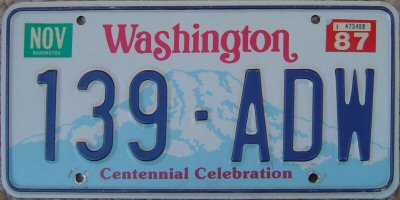

In 1990, they dropped the "Centennial Celebration" motto. The single "A" here means commercial vehicle.

1990-present. After 1990 they switched to uppercase letters in a Swiss font for the state name, and added a motto at the bottom. They ran out of numbers and had to add an extra digit in the mid-2000s.
 And
this one is a state trooper. (WSP for Washington State Patrol). They
like to mix it up: some unmarked vehicles do this, and some have
completely ordinary plates, while others use the XMT (exempt) logo.
Marked vehicles always either have these WSP plates or the exempt logo.
At around the same time (mid 2000s), they decided that license plates needed to be replaced every 7 years. The justification was that the paint and reflective material that the plate is coated with sometimes wears out. As far as I can tell, the only plates that this actually happens to are on vehicles that are very frequently subjected to high pressure washing, such as municipal buses. Ordinary weathering and car washes don't seem to hurt it much. This was found very annoying to most Washingtonians--rating #5 in a poll of the laws they'd like to see changed. Not only was it obviously a waste of resources, it forced you to learn a new license plate number every few years. It turned out you could get the old number back (for a few dollars and about a month's delay), but you had to know to ask. In 2014 this law was overturned.
At around the same time (mid 2000s), they decided that license plates needed to be replaced every 7 years. The justification was that the paint and reflective material that the plate is coated with sometimes wears out. As far as I can tell, the only plates that this actually happens to are on vehicles that are very frequently subjected to high pressure washing, such as municipal buses. Ordinary weathering and car washes don't seem to hurt it much. This was found very annoying to most Washingtonians--rating #5 in a poll of the laws they'd like to see changed. Not only was it obviously a waste of resources, it forced you to learn a new license plate number every few years. It turned out you could get the old number back (for a few dollars and about a month's delay), but you had to know to ask. In 2014 this law was overturned.


Special interest plates. There are quite a few more, not shown here. The one in the upper right is for an antique vehicle. The "Year" is the year of the vehicle, not of the plate.
references:
http://www.dol.wa.gov/vehicleregistration/sphistory.html
http://staff.washington.edu/bbirt/wahist~1.htm
Wikipedia's article on this subject
An absolutely astonishing collection of license plate photos can be found here: He has 5 pages on Washington State alone! 1976 y2k y2k2 y2k3 y2k4
13 February 2013
Why is Too Much Speculation Bad?
The largest pieces of the Bush tax cuts were cuts on speculation: specifically, Long Term Capital Gains, Dividends, and Carried Interest. These are all mechanisms by which speculators make profits. These profits contribute very little to the economy as a whole, but they make a few people very rich. Until the "Fiscal Cliff" settlement last month, they were all taxed at 15%--less than half the marginal rate for rich people. This is a very powerful incentive for figuring out ways to make your money in these areas.
Of itself, this might be harmless, but because it occurs in competition with the rest of the economy, a lot of investment chooses to be done in these low-tax areas, which has the effect of driving investment out of areas that can create more jobs. We need some speculative investment: it creates a back end for IPOs and commodity production, but if we over-incentivise speculation, it actually reduces investment in the very thing we're trying to stimulate: manufacturing, engineering, services, etc. Productive business. This further increases competition for the few remaining speculators, which makes it harder and harder for small investors to compete.
It gets worse: the board members of the productive businesses make most of their income by being shareholders, so they have a huge incentive to increase the short term profitability, and thus their share price, at the expense of the employees, the product quality, and the long term viability of the business. Not all do this, but since their personal competition is largely with people who make their income by speculating, a lot do. So they cut long term expenses--pensions, health care, employee training, etc. Now the other businesses, the ones whose board were behaving responsibly, are at a disadvantage, so they have little choice but to cut benefits too.
We need speculation. But too much of it is worse than too little. With too much, we have wrecked the greatest engine for economic growth the world has ever seen. It may not be too late. But eventually it will be.
10 February 2013
Centrifugal Spaceships

Back when we still thought we were going to spend the next 50 years exploring space, one of the popular ideas was to implement artificial gravity by putting passengers and crew into a big centrifuge. Wernher von Braun, Chesley Bonestell, Arthur C Clarke and many others included giant, rotating space stations as part of their imagery. These guys understood that lack of gravity was a real problem and thought dealing with that was critically important. As real experience with humans in space as been accumulated, the consequences of "microgravity" have been recognized to be even more serious than they'd feared, leading to bone loss and other problems. So why is it that we haven't built spinning space stations?
The reason is that there turned out to be lots of other problems that were equally, or maybe even more serious. Simply getting stuff up there has proven incredibly challenging, and the economics have worked out that many, small, unmanned satellites provide a much better return than putting humans up there. Secondly, the reality turned out to be that the political advantage gained by the space race was fairly limited to "beating the Russians". Once that was accomplished, there was really very little popular support for the space race. So there was little support for big ideas like the space station in the image above (by Bonestell), which inspired Arthur C Clarke and Stanley Kubrick in their movie 2001: a Space Odyssey. The space station we've actually got, 12 years after 2001, has a pressurized volume of 29,600 cubic feet--about what 3700 square feet of building have. Much of this is filled with equipment, so the living space is really no more than that of a moderate family house.
If all that space were organized into a ring like the one above-12 feet wide by 8 feet high, the ring would be a mere 64 feet in diameter. To spin it fast enough to make a 1/6th G (lunar gravity) would take 7RPM, or fast enough to make 1 G, it would take 17RPMs. Ridiculously fast, and not really practical if you're trying to take a look outside or dock a spaceship. To get it down to the stately speeds we saw in "2001", it would have to be a half mile or more in diameter. At that size, lunar gravity can be simulated with just one RPM. The centrifuge inside the "Discovery" spaceship, where we first met movie astronaut Frank Poole jogging, was about 50 feet in diameter, so it would have to spin even faster. I'm sure for really long trips, like the one they're on in the movie, space ships would have to contain such centrifuges. I think that's about the smallest practical human centrifuge though. Eventually, we'll have big, kilometer diameter or bigger space stations, and I have great hope for O'Neill Cylinders some day in the future. But not for a while yet.
Subscribe to:
Posts (Atom)