22 February 2013

Clarke's Laws

 Science Fiction Author, Scientist and Futurist Arthur C. Clarke wrote about three laws of science:
  1. When a distinguished but elderly scientist states that something is possible, he is almost certainly right. When he states that something is impossible, he is very probably wrong.
  2. The only way of discovering the limits of the possible is to venture a little way past them into the impossible.
  3. Any sufficiently advanced technology is indistinguishable from magic.
Another way of stating the first law is that "science proceeds one funeral at a time." The innovators of each generation are greeted with skepticism, often forceful and political, by the vested interests of previous generations.  Only through death can that forceful skepticism be overcome.  Max Planck said it, Thomas Kuhn wrote a whole book about it.

I think the second law speaks for itself.  It's true in other areas too.  Racing drivers "Test" their car and the track by finding what is too much and driving as close to the edge as they dare.

The third law is the most interesting, and when somebody talks about Clarke's Law (singular) this is the one they're referring to.  Even in a technological society like ours, most people operate as if the technologies they are using are magic.  How many cell phone users understand even a little about how they work?  I know very competent engineers who don't understand anything less vague than that they're a radio, and don't understand what a "Cell" is.  (the key innovation that made them possible was the cellular handoff algorithm, allowing handoffs between radio towers organized in a cellular pattern).  The television, the car, the computer are all this way.  I don't think many people in our society actually believes that they're magic, but they believe they need to defer to an arcane expert to do maintenance, often rejecting their own abilities in favor of purported expert.  What percent of the population really understands these things well enough to work on them?  (although the reality with a lot of stuff, especially microelectronics and software, is that there are barriers to entry which are not intellectual.  I can't work on the traces inside an already-built integrated circuit, even though I know how they work and have helped design them.  They're too small.  And a lot of stuff is intentionally secured from access, for reasons ranging from IP to national security)

Clarke talked about three generations of technological advance:  One generation invents it, the next deploys it, and the third takes it for granted.  Anyone in the inventing generation or earlier (and we're talking about their knowledge and analytical tools, not when they were born) who finds themselves in the "for granted" context, sees it as magic or it's equivalent.  This may be because they come from sufficiently different culture, or it might literally be generational.

In the early 70s, I had a long conversation with my grandmother about computers predicting the weather.  I was 17 and had recently learned to program in BASIC.  She was a very smart woman (one of her sons was an economics professor and the other a rocket scientist) but she could not understand that the computer really was just a tool, and in no way capable of independent thought like a human, or even a dog.  We had to teach it everything.  the fact that computers were being used to predict the weather is entirely based on their capacity to implement human algorithms more quickly than humans can, not that they have any inherent knowledge or ability that humans lack.  My grandmother, smart as she was, couldn't make this leap.

It's not always the case that the "for granted" generation treats a thing as magic.  The four stroke engine was invented in 1876 by Nicholas Otto and commercialized by him and his one-time employee Gottlieb Daimler.   Henry Ford figured out how to deploy it on a massive scale in the early years of the 20th century, and from about 1920 on, nearly every American had access to one.  Many of them became competent mechanics and invented many things using them.  How many mines, machine shops, sawmills, and other tiny industries had a Model T at their core, especially during the Great Depression.  Even the Amish use horse drawn wagons that are built using automobile wheels and bearings.   This continued for at least three generations. It's only the last few decades that people started giving up.

15 February 2013

Washington State License Plates

Before 1963
Before 1963, a new plate was issued every year, with a different color each year.  They tended to be green or blue on white or silver or grey, or the lighter color on green or blue.   Prewar plates tended to be collected for scrap metal so they are quite rare.  During the war they didn't issue plates, only window stickers.
1947

1958

Starting in 1958 they went to three letters and three numbers.  During 1963, they issued permanent plates in 1963's color--green on white, which served for the life of the car.  A sticker was added each year.  Prior to 1965, the word "WASHINGTON" was abbreviated "WASH", which apparently annoyed some folks, so a bill was passed in the state legislature banning that abbreviation for license plates.
 1963-87
Vanity plates began being issued in 1975. In the 1980s they were green on yellow

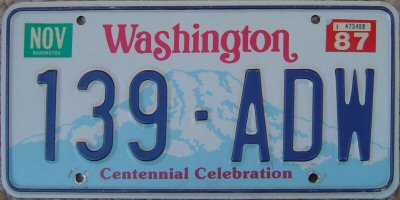
In the leadup to the state centennial in 1989, they began issuing plates with a picture of Mount Rainier in the background with the state name in a curly font in upper and lower case, and the position of the numbers and letters were switched.  This is a  1987-1989 "Centennial" Plate
 In 1990, they dropped the "Centennial Celebration" motto.   The single "A" here means commercial vehicle.


1990-present. After 1990 they switched to uppercase letters in a Swiss font for the state name, and added a motto at the bottom.  They ran out of numbers and had to add an extra digit in the mid-2000s.

And this one is a state trooper. (WSP for Washington State Patrol).  They like to mix it up: some unmarked vehicles do this, and some have completely ordinary plates, while others use the XMT (exempt) logo. Marked vehicles always either have these WSP plates or the exempt logo.

At around the same time (mid 2000s), they decided that license plates needed to be replaced every 7 years.  The justification was that the paint and reflective material that the plate is coated with sometimes wears out.  As far as I can tell, the only plates that this actually happens to are on vehicles that are very frequently subjected to high pressure washing, such as municipal buses.  Ordinary weathering and car washes don't seem to hurt it much.  This was found very annoying to most Washingtonians--rating #5 in a poll of the laws they'd like to see changed.  Not only was it obviously a waste of resources, it forced you to learn a new license plate number every few years.   It turned out you could get the old number back (for a few dollars and about a month's delay), but you had to know to ask.   In 2014 this law was overturned.


Special interest plates.  There are quite a few more, not shown here.  The one in the upper right is for an antique vehicle. The "Year" is the year of the vehicle, not of the plate.


references:
http://www.dol.wa.gov/vehicleregistration/sphistory.html
http://staff.washington.edu/bbirt/wahist~1.htm
Wikipedia's article on this subject

An absolutely astonishing collection of license plate photos can be found here: He has 5 pages on Washington State alone!  1976 y2k y2k2 y2k3 y2k4

13 February 2013

Why is Too Much Speculation Bad?

The largest pieces of the Bush tax cuts were cuts on speculation: specifically, Long Term Capital Gains, Dividends, and Carried Interest.  These are all mechanisms by which speculators make profits.  These profits contribute very little to the economy as a whole, but they make a few people very rich.  Until the "Fiscal Cliff" settlement last month, they were all taxed at 15%--less than half the marginal rate for rich people.  This is a very powerful incentive for figuring out ways to make your money in these areas.

Of itself, this might be harmless, but because it occurs in competition with the rest of the economy, a lot of investment chooses to be done in these low-tax areas, which has the effect of driving investment out of areas that can create more jobs.  We need some speculative investment:  it creates a back end for IPOs and commodity production, but if we over-incentivise speculation, it actually reduces investment in the very thing we're trying to stimulate: manufacturing, engineering, services, etc.   Productive business. This further increases competition for the few remaining speculators, which makes it harder and harder for small investors to compete.

It gets worse:  the board members of the productive businesses make most of their income by being shareholders, so they have a huge incentive to increase the short term profitability, and thus their share price, at the expense of the employees, the product quality, and the long term viability of the business.  Not all do this, but since their personal competition is largely with people who make their income by speculating, a lot do.  So they cut long term expenses--pensions, health care, employee training, etc.  Now the other businesses, the ones whose board were behaving responsibly, are at a disadvantage, so they have little choice but to cut benefits too.

We need speculation.  But too much of it is worse than too little.  With too much, we have wrecked the greatest engine for economic growth the world has ever seen.  It may not be too late.  But eventually it will be.

10 February 2013

Centrifugal Spaceships


Detail of space station (Reproduced courtesy of Bonestell LLC)

Back when we still thought we were going to spend the next 50 years exploring space, one of the popular ideas was to implement artificial gravity by putting passengers and crew into a big centrifuge.  Wernher von Braun, Chesley Bonestell, Arthur C Clarke and many others included giant, rotating space stations as part of their imagery.   These guys understood that lack of gravity was a real problem and thought dealing with that was critically important.  As real experience with humans in space as been accumulated, the consequences of "microgravity" have been recognized to be even more serious than they'd feared, leading to bone loss and other problems.  So why is it that we haven't built spinning space stations?

The reason is that there turned out to be lots of other problems that were equally, or maybe even more serious.  Simply getting stuff up there has proven incredibly challenging, and the economics have worked out that many, small, unmanned satellites provide a much better return than putting humans up there.  Secondly, the reality turned out to be that the political advantage gained by the space race was fairly limited to "beating the Russians".  Once that was accomplished, there was really very little popular support for the space race.  So there was little support for big ideas like the space station in the image above (by Bonestell), which inspired Arthur C Clarke and Stanley Kubrick in their movie 2001: a Space Odyssey.  The space station we've actually got, 12 years after 2001, has a pressurized volume of 29,600 cubic feet--about what 3700 square feet of building have.  Much of this is filled with equipment, so the living space is really no more than that of a moderate family house.

If all that space were organized into a ring like the one above-12 feet wide by 8 feet high, the ring would be a mere 64 feet in diameter.  To spin it fast enough to make a 1/6th G (lunar gravity) would take 7RPM, or fast enough to make 1 G, it would take 17RPMs.  Ridiculously fast, and not really practical if you're trying to take a look outside or dock a spaceship.  To get it down to the stately speeds we saw in "2001", it would have to be a half mile or more in diameter.  At that size, lunar gravity can be simulated with just one RPM.  The centrifuge inside the "Discovery" spaceship, where we first met movie astronaut Frank Poole jogging, was about 50 feet in diameter, so it would have to spin even faster.  I'm sure for really long trips, like the one they're on in the movie, space ships would have to contain such centrifuges.   I think that's about the smallest practical human centrifuge though.    Eventually, we'll have big, kilometer diameter or bigger space stations, and I have great hope for O'Neill Cylinders some day in the future.  But not for a while yet.

04 February 2013

Pieces of Paper

"Fiscal Conservatives" imagine that it's impossible to create wealth by printing pieces of paper. That's true, but the way that you distribute those pieces of paper is important--and you can stimulate the economy in ways that actually do create wealth by doing that.


It's true.  Adding printed money, or the electronic version of the same, to the economy only dilutes the wealth that is out there.  But the way you do it matters.  For example, if you give it all to a few people, in exchange for nothing, those people have now captured an accordingly large share of the wealth in the society, for doing nothing.  If those people just store it away and don't spend it, the effective influence on the economy is small--the people who got the new money are richer, but the functioning economy isn't.  The people who didn't get the money are poorer than they were before: they have the same number of dollars, but those dollars have less buying power.  Only a little though: the rich people have kept most of the dollars out of circulation.  Distributing money this way can prop up an economy at risk of deflation: if the rich people are scared enough, they'll take money out of circulation, which makes individual dollars worth more, but it means employers can't afford to hire and consumers can't afford to spend...a very bad situation for an economy.  Many economists regard deflation as the indicator that defines a depression.

If, however, you give the pieces of paper to people who are having trouble getting work , this can overcome a demand problem.  Lack of demand is a vicious cycle: Employers can't sell their products, so they cut back on workers, who now don't have enough money to buy stuff, so they cut back on spending, further reducing demand.  Giving money to unemployed people can break this cycle.  It does dilute the value more immediately, because poor people tend to spend their money right away.  But this creates demand, encouraging employers to hire and invest, which can create real wealth.  And at least at first, it increases the buying power of those who get it.

The Bush and Obama administrations mostly did the wrong things: giving the pieces of paper to banks, and cutting taxes.  Since poor people don't pay much in taxes to begin with, tax cuts, even if they're mostly directed towards poor and middle class people, tend to favor the rich.   A 2 percent tax cut for a middle class person may be sufficient to create 1/50th of a job, so it's not nothing, but a 2 percent tax cut for a rich person may be enough to create several jobs.  But rich people don't need to spend the money right away, so they tend not to--and if the economy is bad, they're especially prone to saving the money.    The government would have been much better off creating the jobs directly: spending on infrastructure.  This would have directly impacted the construction industry, the one hurt worst by the crash in the housing bubble, and it would have left behind new roads and transit for all of us to use in the future.  Even giving the money to banks, as was done with TARP, could have been done in a better way.  By requiring recipients to lend in ways consistent with what they'd done before the bubble, they could have boosted the construction industry and the economy as a whole.  Probably not enough to reverse the crash, but enough to slow it some.  Instead, the banks just pocketed the money--redistributing upwards, and ending the bank panic, but not slowing the wider crash at all.

14 January 2013

Who Benefits From Austerity?


For ordinary people, including families and businesses, when they find they have a budget shortfall, they either need to increase revenue somehow--get a job, for example--or practice austerity--belt tightening, cutting back on expenses.  Putting off buying a car, moving to a house with lower rent or mortgage, perhaps even smaller measures, like saving a little on food or entertainment, may make the difference between positive and negative cash flow.  But what happens if a whole community is having a budget shortfall at the same time?  One persons spending is another persons income.  What happens is the whole community declines--a "race to the bottom".   John Maynard Keynes called this "the paradox of thrift".  They only way to break the vicious cycle is for somebody to spend.  Often this is an outsider.  If a community can attract an outside business by giving it tax breaks or other concessions, it creates employment for locals.  But in the larger economy, this is a losing game.  If you attract Walmart or a factory to your community by giving it tax breaks or a non-union workforce, you have deprived the businesses that tried to compete with Walmart of their revenue, including other communities, you've deprived yourself of taxes to provide necessary services such as roads and welfare, and you've deprived your workers of protections from abusive management.  The factory was going to go somewhere.  Your town may benefit over the short term, but the larger economy does not.

Government can play the role of the outsider--government spending doesn't doesn't really come out of the economy--nearly all that spending goes to businesses and workers.  It's merely redistributive.  Moreover, provided government taxes equally, those taxes don't hurt anybody--everybody is left with exactly the same buying power.  Government is one of the few organizations whose interests are purely those of the country at large.  It risks being corrupted--to redistribute unfairly, to those with political influence--but as long as most decision making is conducted in the open, the people have a chance to fight this.

Government debt is unlike family or business debt, or even that of a larger community, like a state.  The small unit can get itself over a bad spell with austerity.  But the government cannot.  Broad austerity just lowers spending for everybody.   But there's a way out: the government has the ability to print money.  Too much of this causes inflation, with the instability that brings, but within moderation, this can be a good thing.  Among other things, inflation makes debts get smaller.  The people who sell debt try to calibrate them to inflation, but there's a market for that, and if they go too far, the borrower will look elsewhere.  Government, uniquely, has the ability to set its own rates.

So who is it that is trying to convince us that government austerity is an important thing?  The people who make a profit by keeping interest rates high relative to inflation--the people who are lending to government: the big banks.  The thing they least want is for government to inflate its debt away.  They have an easy to understand analogy that their spokesmen and lobbyists pitch: family belt tightening.  But the government is not a family.  Do they care that their greed is keeping the economy down and ruining the future prospects of tens of millions of Americans?  Not a whit.

No country has ever cut it's way to prosperity.  Government and business spending is the only way it's ever been done.  Neither is happening right now, and it's killing us.

12 January 2013

The Disenfranchisement Strategy

One of the most insidious rhetorical strategies is to disenfranchise your opponent.    This can occur in many ways, but logically, they boil down to the "no true Scotsman" falacy:  believing such a thing renders you unworthy to participate.

At the moment, a series of mass shootings has elevated the topic of gun control in the public consciousness.  The gun lobby, predictably, says that after such a shooting is not the time to have such a discussion and we shouldn't let our emotions overcome the supposedly reasoned position they want us to take.  These shootings have become so commonplace that by that logic, there will never be a time to discuss this.  Of course, that's exactly what they want.  Their goal is to disenfranchise everyone who disagrees with them.

The "voter fraud" meme became a popular strategy for the Republican party in 2004, when they first started losing a few elections.  Here in Washington State, Dino Rossi attempted to prove that illegal voters in Democrat leaning districts had boosted their results.  When the courts did a careful examination, nearly all of the "illegal" registrations proved to be a misunderstanding on the part of those claiming voter fraud.  In fact, election fraud is quite an old problem, and the Republicans have been very guilty of it.  This came to a particular head in November 2000.  Using a technique called "caging", legitimate voters with recent address changes in districts tending to vote Democratic were sent a letter.  The addresses included soldiers recently called to duty, college students, and others who would likely be living at a temporary address.  The subject of the letter contained harmless Republican politicing, but the trick was on the envelope itself, which said "Do Not Forward".  Letters returned to sender would be used to generate a list, which was sent to a cooperative voter registration officer to remove those names from the list of registered voters.  At least 40,000 such names were removed from Florida polls shortly before the election of 2000.  The official (not recounted) result from this election was Bush winning by 537 votes.  When attempts to recount the ballots that were cast were made, Republican troublemakers disrupted the recount effort, culminated in the Republican-dominated supreme court determining that it was impossible to complete a recount in the time available.  In the election of 2004, evidence for hundreds of thousands of miscounted or bogus votes in Ohio, Florida and other swing states--more than enough to change the result and consistent with the surprising difference between exit poll results and the final tally.

In 2012, many states had efforts to disenfranchise voters by requiring them to have some piece of ID that would be difficult to obtain if they were poor--generally called "voter suppression laws".  The courts overturned most of these, but several Republican operatives openly admitted that the strategy was disenfranchisement of voters likely to vote Democratic.

William F Buckley was a master of techniques that would confuse or quiet his opponent.  The simplest and most frequently used was to shout louder--Bill O'Reilly and a number of others frequently use this technique today.  But another was to say something that would leave his opponent confused or startled, during which time Buckley would prattle on about his own position, leaving the quieted opponent looking helpless and foolish.  During a panel discussion after the TV nuclear winter movie "The Day After", Buckley said "But don't you think [the movie] is tendentious?"  It was obvious that nobody else on the panel knew what the word meant, but didn't want to admit it.  (I had to look it up.  Tendentious means "intending to promote a particular point of view, especially a controversial one")   The correct response was "yes, of course it is, that's the whole point of the movie."

The Republicans strategy in the late 90s and early '00s was to create a "Permanent Republican Majority", to make sure they'd preserve power even if they couldn't win it legitimately. In quite a few states, they've gerrymandered congressional districts to the point that even though there were a clear majority of Democratic votes, the states sent a Republican congressional delegation.  They've been very good at winning the elections that counted for redistricting: 2000, 2010, by hook or by crook, and have used those wins to retain power against fairly severe defeats.

The current US Senate filibuster is another illustration: if the majority can't muster 60%, the minority can block any measure or nomination, simply by saying so.